Showing posts with label religion. Show all posts

Monday, January 18, 2016

History vs Mythology - Ramayana and Mahabharat

History vs Mythology - Ramayana and Mahabharat

Ramayana and Mahabharat document the ancient Indian history. But those are not considered as formal history texts in Indian Universities. Why?

First of all Ramayana and Mahabharat is considered as Itihasa. Itihasa means old narratives. In a sense it is the history of India. But there are few differences which need to be addressed before marking these as formal history texts.

1. Human History - When we say history in academic sense, it is referred to Human history, documentation of Human civilization. It does not cover the history of deities or Devatas like Indra, Varuna etc and demons or Rakshasa like Ravana, Bakasura etc.

Whereas books like Ramayana and Mahabharat contain both Human history along with the history of Devata and Rakshasa. So people don't accept history of Devata and Rakshasa as natural evolution of civilization. Those are considered as a part of mythology.

2. Earthly events - Generally history documents social, political, economical, cultural events or protocols present in past civilizations on earth. It does not cover the supra-cosmic events happened in heaven or hell.

Whereas Ramayana and Mahabharat contain past events occurred on earth as well as from heaven and hell. For example - Arjuna going to heaven for one year, Dasaratha went to heaven to help Indra etc. Yudhistira went to hell with own body as a visitor, Krishna brought dead son of a Brahmin etc. Those are considered as mythology because it does not fit into normal human perception.

3. Teachings - The purpose of history is to document the past events without any interpretation. For example - King Ashoka killed all in Kalinga, converted into Buddhism and spread Buddhism throughout the world. But history does not extend to incorporate Buddha's teaching. Because teaching is an interpretation to be covered in other stream of knowledge. Those are not a part of history.

Whereas Ramayana and Mahabharat contain past events along with teachings. For example - Vishma was sleeping on arrow bed and Krishna met him along with Pandavas. Then teaching given by Vishma is described at length. Similarly in battle field Krishna-Arjuna discussion is narrated as sacred book Gita. So these books also incorporate philosophies, moral teachings, and spiritual teachings. So people don't accept those as history or mythology. Rather those could be fit into philosophy stream.

4. Consistency -  In any stream of knowledge consistency is a challenge. Historical events are studied keeping sequence of events, possibly with time period. Also information should be consistent across all authors or books.

Whereas Ramayana and Mahabharat contain a lot of inconsistent events. Rama ruled for 11,000 years. His father Dasaratha also was said to have lived for 16,000 years.  Krishna met Jambuban of Treta. Krishna was dancing with sixteen thousand girls and then got married to another set of sixteen thousand girls. Radha, the lover of Krishna is NOT mentioned in Mahabharat, but she is a popular character in today's Krishna temple. Many such events are conflicting in various Puranas like Bhagavatam etc. So rational mind considers those as mythology.

5. Miracles - History covers incidents. It does not covers accidental miraculous events.

Whereas  Ramayana and Mahabharat contain many such miracles. Krishna lifting mountain in little finger. Ravana was moving in a magic flight, Hanuman jumping Indian ocean etc. So people does not accept these because there is no such scientific explanation of these events.

We need to remove all super-natural events, characters from these two books to be considered as history. 

6. Authenticity - Any stream of knowledge must be authentic including History. For example the existence of Buddha is known from various stone images and writings presents on stone. Writings from stones, discoveries from various monuments, study of metals, soils gives clue about past. For example Harappan Civilisation.

Whereas events documented in Ramayana and Mahabharat do not mention source of information - What are places, which period etc. For example Ravana is from Sri-lanka or not? Was Rama born in current Ayudhya or some other place? Where is the birth place of Krishna in current India? There are no uniform answers to all these events. So people doubt authenticity of places and events.

7. Author - Any information without author name is irrelevant. This is very important in case of History. People go by the authority of that person in that stream of knowledge.

Ramayana is written by Valmiki. Some says he wrote through visual meditation because he did not know Rama until Narada revealed it. It seems he also wrote beforehand what Rama is going to do in future. There are thousands Ramayana in Sanskrit and local languages. In one Ramayana in Sanskrit,  where Sita is Ravana's sister and Rama kidnapped Sita. So there was a fight between Rama and Ravana. Similarly Vyasa wrote Mahabharat through Ganesha from heaven. And same Vyasa wrote many Puranans, all are inconsistent. Buddha is mentioned by Vyasa in Bhagavatam. Then Buddha is before Vyasa or after Vyasa? Some say Vyasa is just a title of publishers. There were many Vyasa, many Suta-muni etc.

8. Rituals - It is mentioned in various Smritis and Sutras, during rituals, Kings used to arrange discussion and speech program as pastime. Because the rituals like Ashvamedha, Rajasuya, Putra-kamesti Yajna use to continue for months. And whole day people cannot chant mantra. So during the gap, as a refreshing or entertaining activities, people used to describe about past kings and past events. At later point of time those tales are documented as Ramayana and Mahabharat. Since these tales are associated with rituals, there were various narrators, so there are inconsistencies. Every preacher wants to highlight their lineages through exaggeration. People added a lot of miraculous stories on the top of real facts, diluted facts to get public attention, name and fame.

And in due course of narration they have also described the process followed in those rituals. For example in Ashvamedha Yajna, the queen had to sleep with dead horse over night for symbolic sex, killing of animals in yajna facing towards a particular direction, various objects required for those rituals etc. So these rituals cannot be a part of history. And people consider those as mythology.

9. Religion - People keep History subject as a secular subject. So people do not want to include spiritual process or methods like Yoga, Vedanta, Advaita topics into History.  Life of saints can be included, but the sadhana or paths followed by them should be kept out of history context.

Whereas Ramayana and Mahabharat contain spiritual topics, religious protocols, caste system, Svadharma based on caste etc. And many will NOT be interested in these Hindu religious topics. These books also do not include Buddha's method, Jain's method etc. So these texts are looked as belonging to a particular religious sect. These are not organized as a universal history book.

10. Foreign driven - The most interesting thing is our history is driven by foreigners. We have collected data from foreign visitors like Hiuen Tsang, Al-Biruni etc. Indian never documented anything other than few Sanskrit books.

Indian Sanskrit books talk of cyclic civilization like Satya-Treta-Dvapara-Kali. It includes both evolution and involution of human progress. So the time is cyclic. Whereas western thought process is linear civilization. That includes only evolution as a linear human progress. So their historic time is linear. Indians were never history centric, rather they were Purana centric. So Indians have to revisit their strategy to migrate from mythology centric to history centric study.

11. Ordinary humans - Generally History considers humans from all social layers in a balance way. It covers starting from Kings, businessmen, till ordinary human life style.

Whereas our Puranas are centered around few Kings as a major information. Ordinary human lives, social issues are not highlighted. So there is an imbalance in documentation. Whereas history centric people try to learn about ordinary citizens and their life styles, general politics, people culture etc. Those are missing from Ramayana and Mahabharat.

Rama left home to keep father's promise – obedient to father. Was it a normal life style for ordinary citizen or Rama was unique? Draupadi got married to five brothers - polyandry and she was paraded naked in Indian parliament in front of all ministers and her own five husbands – no dignity of women. Vidura was a Dalit, still became the India's PM – caste is not a bottleneck, Vyasa did sex with three dead cousin's wife to give birth to Dhrutarastra, Pandu, Vidura – Liberal sex life, Krishna kidnapped Rukmini – love marriage. Were these events common to general public or these were unique to royal family?

This is another reason, why people do not correlate these events to their day-to-day lives. They think these are not humanly possible for ordinary citizens. So whatever values or morals taught in these texts do not influence normal humans. So in India there is a lot of corruption, harassment, untouchability, because people are not inspired to practice these texts in action, though they preach these in words.  Basically people revere Rama, Krishna, Pandava, Vishma etc as role models. But they do not put into action thinking they were super-natural actors with special divine power. People do not accept those as history of common man, or actions from common man.

12. Conclusion

So we need to consider Ramayana and Mahabharat as a superset of History book. These contains past events, morals and spiritual teachings, religion, various Yogas, history of Devata, Rakshasas, miracles etc.

We need to filter all these super-natural facts to give it a status of history. And there are a lot of superstitions which are considered as tradition due these Puranas. Because people remember these facts eternally as Hindu tradition. For example, following caste system, believing in demons and various non-vedic demi-gods, practice of unhygienic rituals – e.g. throwing dirt into river Ganga in the name of purity etc. So we need to demarcate the ancient ‘secular’ social customs from ‘religious’ Hindu tradition. History must be analyzed in a secular, scientific and data driven method.

Swami Vivekananda nicely said - "The Smritis and the Puranas are productions of men of limited intelligence and are full of fallacies, errors, the feelings of class and malice. Only parts of them breathing broadness of spirit and love are acceptable, the rest are to be rejected. The Upanishads and the Gita are the true scriptures."

Sunday, September 27, 2015

God Incarnation and Ordinary Guru - a contrast

God Incarnation and Ordinary Guru
(By Muktipada Behera)


Introduction:

The theory of Isvara Avatara (God Incarnation) is quite old. It is described in detail in Purana and Itihasa like Srimad Bhagavatam, Bhagavad Gita etc. It is also described in Bhakti Sastra like Chaitanya Charitamrita, Sri Ramakrishna Kathamrita and Bhakti Yoga by Swami Vivekananda. There is no mention of Human Avatara in Veda. May be those portions of Veda mentioning God incarnation on earth is lost. However, Kena Upanishad, Chapter 4 mentions God incarnation as Yaksha in heaven. Devas could not recognize him. So Brahman personified as Uma Haimavati instructed Indra on the eternal truth behind all that is perishable and said – “That Yaksha was Brahman”.

It is undoubtedly true that God comes down to earth in a human form, as in the case of Krishna. And it is true as well that God reveals Himself to His devotees in various forms. But it is also true that God is formless; He is the Indivisible Existence-Knowledge-Bliss Absolute. He has been described in the Vedas both as formless and as endowed with form. He isalso described there both as attribute-less and as endowed with attributes.

Gita 4.7

yada yada hi dharmasya glanir bhavati bharata
abhyutthanam adharmasya tadatmanam srjamy aham

Whenever and wherever there is a decline in religious practice, O descendant of Bharata, and a predominant rise of irreligion—at that time I descend Myself.

Gita 4.8

paritranaya sadhunam vinasaya ca duskrtam
dharma-samsthapanarthaya sambhavami yuge yuge

In order to deliver the pious and to annihilate the miscreants, as well as to reestablish the principles of religion, I advent Myself millennium after millennium.

Everyone is also an avatara based on its past Karmas. Avatar is for devotee, not for Jnani. A Jnani (Individual with supreme knowledge) knows Brahman has become everything including all Human beings.

Explanation of Avatara:

God Incarnation can be explained through the illustration of the ocean and the ice.

Satchidananda is like an infinite ocean. Intense cold freezes the water into ice, which floats on the ocean in blocks of various forms. Likewise, through the cooling influence of bhakti, one sees forms of God in the Ocean of the Absolute. These forms are meant for the Bhaktas, the lovers of God. But when the Sun of Knowledge rises, the ice melts; it becomes the same water it was before. Water above and water below, everywhere nothing but water. Therefore, a prayer in the Bhagavata says: 'O Lord, Thou hast form, and Thou art also formless. Thou walkest before us, O Lord, in the shape of a man; again, Thou hast been described in the Vedas as beyond words and thought.'

Difference between Guru and Avatara:

Even though Vedanta talks of “Each soul is potentially Divine”, there is a clear difference between God incarnation and ordinary Human Guru. Here we will outline few differences.

(1)   General Guru descents on earth based on their past Prarabdha Karma. But God incarnation descents on earth due to “Samasti Prarabdha – cumulative Karma” of whole society at that point of time.

(a)   Brahma sutra 3.3.32 Shankara Bhashya says – Yavadadhikaramavasthitiradhikarikanam.
Perfected souls may take a corporeal existence for divine mission. Of those who have a mission to fulfil existence, they take rebirth in due course of time based on need. Examples are – Vasishtha, Narada, Shankaracharya and Swami Vivekananda etc.

(b)   Brahma Sutra 4.4.17 says - Jagadvyaparavarjam prakaranadasannihitattvaccha.
The liberated soul attains all lordly powers except the power of creation, maintenance, and dissolution of cosmos. Only God has those cosmic powers. So there is a clear division of the ownership between liberated soul and God.

(2)   God Incarnation has three main purposes or Sankalpa as per Gita – (a) paritranaya sadhunam – to save pious human beings; (b) vinasaya duskrtam - destruction of spiritual obstacles; (c) dharma-samsthapanarthaya - Rejuvenation of spirituality. Ordinary Guru is not capable to fulfill this high cosmic demand. Ordinary Jiva is manifested through a different Sankalpa - Akoham bahusyam. 

(3)   God incarnation is of Saguna Brahman – Vishnu. Various incarnations get manifested with different power and different qualities or Kala based on social need. For example, Krishna was manifested with complete sixteen Kala – so he was known as Purna Avatara, Rama was born with twelve kala.

(4)   Ordinary Guru transmits spiritual power through Ista Mantra or teachings. Isvara Avatar transmits energy though touch or mere wish. The person can be uplifted immediately and get divine vision. Like Arjuna got the vision from Krishna, Vivekananda got from Sri ramakrishna, on Kalpataru day many got instant spiritual vision by the grace of Sri Ramakrishna, Chaitanya Dev did same for Nityananda.

(5)   God Incarnation has a power to liberate other humans out of grace. They are like a huge ship that can carry many others in bondage. Ordinary guru is compared with a small boat which cannot accommodate many. Human Guru is not capable to liberate others through mere grace.

(6)   God Incarnation demonstrates the moral and spiritual paths relevant to current society. They can change the thought-wave of the society. And then Smritis and other teachers tend to follow that path of reformation. Without God incarnation, ordinary Guru does not have enough power to change this huge cosmic thought-wave.

(7)   Ordinary Guru is a one-man show. Avatar comes with his own group - already illuminated disciples, like Swami Vivekananda along with other fifteen direct disciples of Sri Ramakrishna; Hanuman, Bharata etc came with Sri Rama; Gopis, Arjuna etc came with Krishna; same with Buddha and Chaitanya etc. So the teachings preached by an Avatar has a very strong power and future generations get benefited even after the Avatar has left his mortal body.

(8)   God incarnation has ‘oneness’ from birth. They are aware of their divine nature from childhood. They don't need to practice any Sadhana to get it because they are already liberated and came here to help others.

(9)   An ordinary spiritual Guru gets illumination through Sadhana and initiates his disciples in his realized path. Once the Guru departs the physical body, his followed path becomes weak and does not remain as a strong spiritual current for future generation. Normal Gurus will be popular while they are alive. After their death, people usually forget them and their followers are reduced.  

The preaching done by God incarnation will continue forever even after his death. He will become more popular and get more followers over time. For example, Buddha, Krishna are still popular even if they lived thousand years before. Gita preached by Krishna, life of truthfulness taught by Rama - are still influencing Humans.

How to recognize God Incarnation:

(1)   There is no clear way of knowing who God incarnation is or not. Only another enlightened one can say through his divine vision that somebody is a God incarnation. We must look for a reference from another enlightened person or accept it after having proper clue through own Sadhana.

(2)   Most of the time God incarnation reveals himself to their close disciples while alive. For example, Christ, Krishna have disclosed their real nature to their close disciples. Only ten Rishis knew that Rama was an incarnation.  Ordinary human beings could know them after they are dead.

(3)   Based on qualities seen in earlier God incarnation, Hinduism has developed some standards to judge an Avatar. For example, God incarnations always demonstrate the extreme sense of morals or spiritual values, which ordinary human Gurus cannot achieve in their lifetime. Examples are - Krishna dancing with sixteen thousands Gopis, lifting mountain on little finger, Chaitanya dev extreme adherence to ascetic rule, Sri Ramakrishna keeping Brahmacharya while sleeping with his wife, Buddha’s demonstration of highest compassion, Jesus ready to be crucified alive etc.

It is generally seen - every organization tends to declare their originator Guru as God incarnation out of reverence.

(4)   There are scriptural proof and documented incarnations. Well accepted names are (1) Rama (2) Krishna (3) Buddha (4) Christ (5) Chaitanya (6) Ramakrishna etc. They had imparted tremendous power to reform this world. So they will be followed eternally.

(5)    There are so many Avatars incarnated in India. We don’t worship all of them. We worship the Avatar who is incarnated with his divine consort (Shakti) like Krishna with Radha, Rama with Sita, Ramakrishna with Sarada etc. Whereas Parshurama, Kapila muni, Vyasa deva were also Avatar and we don’t worship them because they were partial incarnation (without associated with Shakti)

Conclusion:

All power Lord descends on earth to do Leela, to play with Humans – his children. It is wonderful to play with the creator. Upanishads say - Raso-vai-Sah - He is like nectar. He is the source happiness or bliss.

"One who has been kissed by Thee, his thirst for Thee increases for ever, all sorrows vanish, and he forgets love for everything else but for Thee and Thee alone." Ay, forget first the love for gold, and name and fame, and for this little trumpery world of ours. Then, only then, you will understand the love of the Gopis, too holy to be attempted without giving up everything, too sacred to be understood until the soul has become perfectly pure. People with ideas of sex, and of money, and of fame, bubbling up every minute in the heart, daring to criticize and understand the love of the Gopis! That is the very essence of the Krishna Incarnation.” – Swami Vivekananda.

Monday, September 14, 2015

Brahman and Creation According to Vedanta

Brahman and Creation According to Vedanta
(Muktipada Behera)


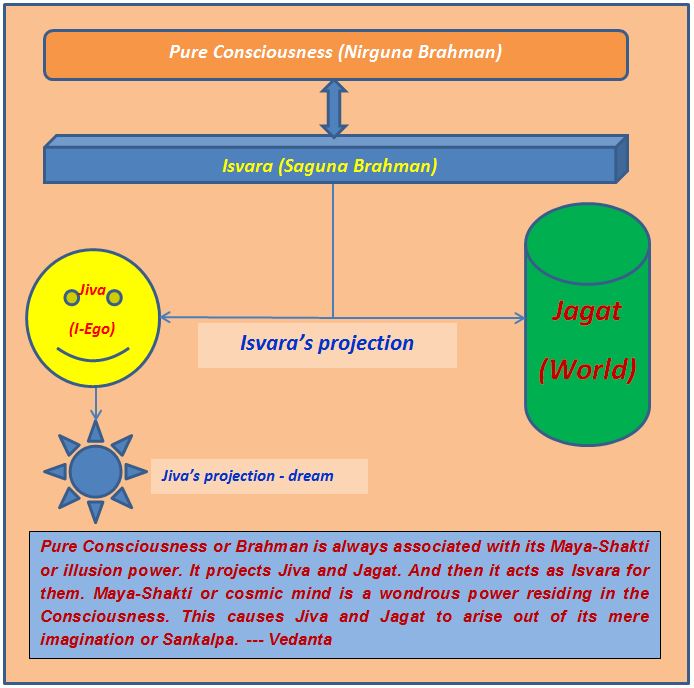
Pure consciousness through its Sankalpa [wish] or will-power projects this creation. Like the spider projects the web and later swallows the web inside. Upanishads mention about this Sankalpa of Brahman - "Akoham Vahusyam - I am one, I will become many".

This Brahman has an inherent wonderful power called Maya-Shakti. This makes him omnipotent. Through this Maya Shakti it projects cosmos. People also call this Maya Shakti as cosmic-mind. So this universe is the Isvara's dream creation - known as Vyavaharika Satya. Each individual also projects its dream world while sleeping - known as Prativashika Satya. And Brahman is known as Paramarthika Satya. So all these in living beings and Universe are in God's dream.

Jiva consists of 24 principle centred around 'I-EGO' or Ahamkara. These 24 principles are Pancha Bhuta, Pancha Tanmatra, Pancha Karmendriya, Pancha Jnanendriya, Manas, Buddhi, Chitta, Ahamkara. Jiva is deluded due to Avidya or ignorance of its true nature Brahman. Each soul is potentially divine. However Jiva forgot it - thinking himself as body-mind complex. This ignorance causes suffering.

Brahman is Satya-Sankalpa. So whatever He imagines manifests into reality or materializes immediately. Brahman is the best artist with excellent imagining capacity or potential. The same does not happen to Jiva due to its limitation. Whatever Jiva thinks it does not materialize into reality.

This creation is Isvara's divine Leela. It is created for divine fun or play. However creation is temporary. It manifests and unmanifests periodically. Brahman is eternal and it sustains creation. It is known as Sat-Chit-Ananda - Existence-Knowledge-Bliss.

Upanishads say - Raso-vai-Sah - He is like nectar. He is the source happiness or bliss. 

From one perspective it appears as Nirguna and from another perspective it appears as Saguna for seekers. So the same entity is both Nirguna and Saguna at the same time. Like with full-stomach in waking state, we can feel hungry while dreaming. So both full-stomach and hungry are true at the same time. Nirguna means niskriya [inactive], all attributes appear unmanifested, but it is not powerless. Brahman appears to be devoid of all attributes. Saguna means sakriya [active] with  all manifested triguna - Sattva, Rajo, Tamo Guna. Brahman is always associated with its inherent illusion power. We don't consider illusion power or Maya Shakti as separate because it does not have separate existence. Maya is associated with Brahman like a shadow with body. 


In the word's Sri Ramakrishna (Exerted from book THE PHILOSOPHY OF SRI RAMAKRISHNA, by SWAMI HARSHANANDA)

'God is formless, and God is possessed of form too. And He is also that which transcends both form and formlessness. He alone knows what all He is.' (Sayings of Sri Ramakrishna, 871).
Sri Ramakrishna calls the Absolute as Brahman, in Its eternal (nitya) aspect, when It is at rest and inactive. The same in Its sportive (lila) aspect, when involved in the process of creation, preservation and destruction, he calls Sakti or Kali, the same as Isvara or God. So, according to Sri Ramakrishna, Brahman and Sakti are one and inseparable. 'The distinction between Brahman and Sakti is really a distinction without a difference. Brahman and Sakti are one (abheda), just as fire and its burning power are one. Brahman and Sakti are one, just as milk and the whiteness of milk are one. Brahman and Sakti are one, just as a gem and its brightness are one. You cannot conceive of the one without the other, or make a difference between them' (Sayings of Sri Ramakrishna, 857).
'God the Absolute and God the Personal are one and the same. Belief in the one implies belief in the other. Fire cannot be thought of apart from its burning power, nor can its burning power be thought of apart from it. Again, the sun's rays cannot be thought of apart from the sun, nor the sun, apart from its rays. You cannot think of the whiteness of milk apart from its milky whiteness. Thus the Absolute cannot be thought of apart from the idea of God with attributes, i.e., Personal God and vice versa. (Sayings of Sri Ramakrishna, 856).
'The Primordial Power and Supreme Brahman are identical - It is like the snake and its wriggling motion.' (The Gospel of Sri Ramakrishna)

In Kena Upanishad Goddess Uma Haimavati taught the power of Brahman to Devas. Without His power, the Agni and Vayu are powerless. 

Saturday, July 4, 2015

religion can be studied through scientific method

Religion can be studied through scientific method
(By Muktipada Behera)

What is Scientific method? And can religion be studied using this method?
We are practically the worshippers of science now-a-days. With this tendency, we try to reject whatever we don't understand, by saying it is not scientific.
But what is this scientific method used to look at things? Here is few points.
1. First of all science works with a 'positive spirit' on a fact or event. To begin with, it does NOT reject any event. Rather it accepts the existence of an event occurred in past. And try to study that. Whereas we try to reject from the beginning in the name of science. And wait for USA to study it.
2. Science is based on verifiability. Science goes by data collection. First required data needs to be collected and later studied to find a pattern. If any patten is found, then it is derived into a formula or law. If there is no such pattern found, then more data is collected for further study. So there is no doctrine of leaving aside any event in science. Science never isolate or reject any event occurred. It believes in a rule - if an event has occurred, then there must be a 'cause' behind it. There can not be cause-less event. Science does not believe in accident, rather it believes in incident.
3. Science is based on repeatability. If an event has occurred once in past, then it must occur in future if similar process is followed and same environment are provided. Please note an event occurs through a particular process under an particular environment. So science not only analyses the event, but also it analyses the process and environment. So these three things are considered by science for research. Not just stand-alone event. In this way the repeatability is verified.
4. When can science say anything is unscientific? No. it does not say anything unscientific. Rather it just deny the confirmation. And open it for further study. So science goes with open mind and open question without negating the fact.
5. Always science is associated with theoretical people in the background. They are called philosophers of science or theoretical scientists. They lead and give directions to study in a particular area. They imagine the beginning of creation, what is inside sub-atomic particles, look beyond sky/galaxy, magic creation of life etc. So these theoretical people are equally respected and funded. They don't have proof, but they have logic and possibility. So attitude is quite positive and passionate.
6. Science does not believe in God and religion. However many scientist believe in God and religion. So indirectly God and religion give power or motivation for their work. For example popular scientists like Copernicus, Galileo, Pascal, Newton, Mendel, Einstein etc used to believe in God and religion. So they have not rejected God and religion as superstition even though they were best prophets of science. Simply they don't assert their believes on science until it is proved as formula/law. But they don't reject it or find contradictory in their lives or research.
7. Can God or religion be a part of science? Yes. It can be. We need to be positive and include this area of study in science - branch named 'spiritual science'. Both system of knowledge - religion and science - are now inimical in nature due to lack of communication among experts of these fields. It requires cooperation from both sides. The religious people should be open for validation. And science people should approach spirituality with a positive spirit. Now-a-days this approach is missing from both religious person and science people. We need to change this attitude and misconception.
8. Finally it is all about funding and setting an awareness. We need laboratory with conducive environment for religious or yogic study. At the same time interest and dedication is required on religion or yoga subjects. For example to prove a theory many scientists have exposed their body to chemicals (e.g. Chemist Karl Scheele died from tasting chemical hydrogen cyanide and mercury poisoning), to radiations (e.g. Marie Curie killed by radiation, Elizabeth Ascheim killed by X-Rays), by starvation (Alexander Bogdanov killed himself with blood) etc. Are we ready to take these risks for spiritual study? Since spiritual study is a subjective study, we need to expose ourselves and our body/mind for it, if we don't get volunteers for it. Like self-climbing the Everest. Let's practice Yoga or religion in a prescribed manner before saying it is wrong. We should not be coward while approaching religion.
9. Another pitfall is, we look for some foreign jack and john to give any formula/law to Indians. Anything published in USA journals, though silly periodicals, even though it is purely theoretical, lacking all kinds of experimental basis, still we Indians start believing in those. For example Darwin's Theory Of Evolution - There is no proof of monkey converting into Human, The Big Bang Theory - creation came out of huge sound, nobody has heard it, Genetic model theory - there is no such genes proved, it is just a model, Bohr's atomic model - there is no way to prove electron position. These are all theoretical concepts for many centuries and not yet proved through experiments. And we never question them. Is it not a blind belief on science? and why not - because it is preached from USA. But anything talked by Indians, we reject however intelligent they may be.
10. I strongly believe every event can be included in science including religion. It requires positive approach, faith in oneself, requires dedication to find a pattern/law/cause. And we have many intelligent people in religious field like Sankaracharya, Swami Vivekananda etc. We can not reject them in void. Sankaracharya has said - "if Veda says - fire is cold, then put Veda into fire, that will prove whether fire is cold or hot". Such a dedication to truth, even dared to burn own scripture. Sankara insisted on direct-realization of truth by an individual - Aparokshanubhuti. Also Swami Vivekananda has said - "If there is any God, we must see it". He used to ask this question - "Have you seen God?" until he found his teacher Sri Ramakrishna at Kolkata, who said boldly - "Not only I have seen God, But I can also show you, if you want". Then Ramakrishna had to show God to swamiji for his confirmation. How practical and scientific approaches are these facts in religious history!
Conclusion:
And without having all these qualities and without proper investigation, let's not reject any religious event. At best we can accept our ignorance on the 'cause' of that event and get ready for further research. This is what is expected from people while approaching religion and Yoga.