Showing posts with label ramakrishna mission. Show all posts

Monday, September 14, 2015

Brahman and Creation According to Vedanta

Brahman and Creation According to Vedanta
(Muktipada Behera)


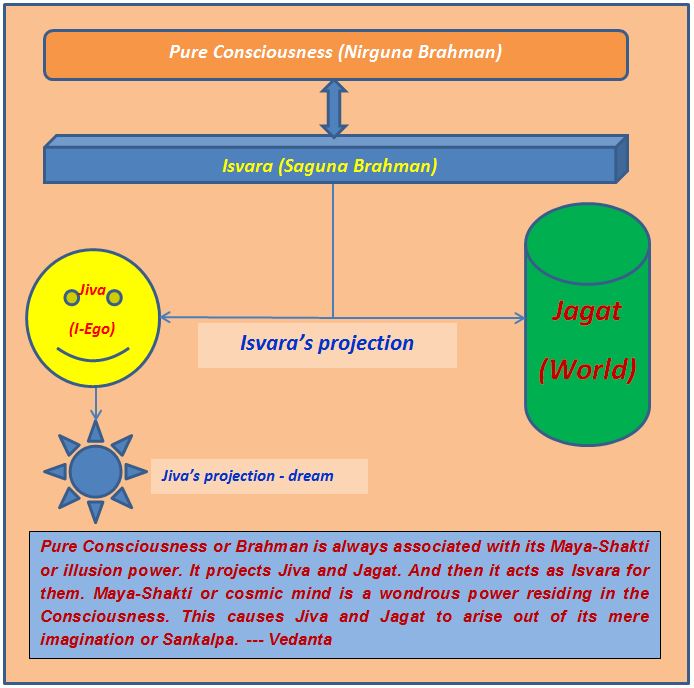
Pure consciousness through its Sankalpa [wish] or will-power projects this creation. Like the spider projects the web and later swallows the web inside. Upanishads mention about this Sankalpa of Brahman - "Akoham Vahusyam - I am one, I will become many".

This Brahman has an inherent wonderful power called Maya-Shakti. This makes him omnipotent. Through this Maya Shakti it projects cosmos. People also call this Maya Shakti as cosmic-mind. So this universe is the Isvara's dream creation - known as Vyavaharika Satya. Each individual also projects its dream world while sleeping - known as Prativashika Satya. And Brahman is known as Paramarthika Satya. So all these in living beings and Universe are in God's dream.

Jiva consists of 24 principle centred around 'I-EGO' or Ahamkara. These 24 principles are Pancha Bhuta, Pancha Tanmatra, Pancha Karmendriya, Pancha Jnanendriya, Manas, Buddhi, Chitta, Ahamkara. Jiva is deluded due to Avidya or ignorance of its true nature Brahman. Each soul is potentially divine. However Jiva forgot it - thinking himself as body-mind complex. This ignorance causes suffering.

Brahman is Satya-Sankalpa. So whatever He imagines manifests into reality or materializes immediately. Brahman is the best artist with excellent imagining capacity or potential. The same does not happen to Jiva due to its limitation. Whatever Jiva thinks it does not materialize into reality.

This creation is Isvara's divine Leela. It is created for divine fun or play. However creation is temporary. It manifests and unmanifests periodically. Brahman is eternal and it sustains creation. It is known as Sat-Chit-Ananda - Existence-Knowledge-Bliss.

Upanishads say - Raso-vai-Sah - He is like nectar. He is the source happiness or bliss. 

From one perspective it appears as Nirguna and from another perspective it appears as Saguna for seekers. So the same entity is both Nirguna and Saguna at the same time. Like with full-stomach in waking state, we can feel hungry while dreaming. So both full-stomach and hungry are true at the same time. Nirguna means niskriya [inactive], all attributes appear unmanifested, but it is not powerless. Brahman appears to be devoid of all attributes. Saguna means sakriya [active] with  all manifested triguna - Sattva, Rajo, Tamo Guna. Brahman is always associated with its inherent illusion power. We don't consider illusion power or Maya Shakti as separate because it does not have separate existence. Maya is associated with Brahman like a shadow with body. 


In the word's Sri Ramakrishna (Exerted from book THE PHILOSOPHY OF SRI RAMAKRISHNA, by SWAMI HARSHANANDA)

'God is formless, and God is possessed of form too. And He is also that which transcends both form and formlessness. He alone knows what all He is.' (Sayings of Sri Ramakrishna, 871).
Sri Ramakrishna calls the Absolute as Brahman, in Its eternal (nitya) aspect, when It is at rest and inactive. The same in Its sportive (lila) aspect, when involved in the process of creation, preservation and destruction, he calls Sakti or Kali, the same as Isvara or God. So, according to Sri Ramakrishna, Brahman and Sakti are one and inseparable. 'The distinction between Brahman and Sakti is really a distinction without a difference. Brahman and Sakti are one (abheda), just as fire and its burning power are one. Brahman and Sakti are one, just as milk and the whiteness of milk are one. Brahman and Sakti are one, just as a gem and its brightness are one. You cannot conceive of the one without the other, or make a difference between them' (Sayings of Sri Ramakrishna, 857).
'God the Absolute and God the Personal are one and the same. Belief in the one implies belief in the other. Fire cannot be thought of apart from its burning power, nor can its burning power be thought of apart from it. Again, the sun's rays cannot be thought of apart from the sun, nor the sun, apart from its rays. You cannot think of the whiteness of milk apart from its milky whiteness. Thus the Absolute cannot be thought of apart from the idea of God with attributes, i.e., Personal God and vice versa. (Sayings of Sri Ramakrishna, 856).
'The Primordial Power and Supreme Brahman are identical - It is like the snake and its wriggling motion.' (The Gospel of Sri Ramakrishna)

In Kena Upanishad Goddess Uma Haimavati taught the power of Brahman to Devas. Without His power, the Agni and Vayu are powerless. 

Wednesday, March 18, 2015

Immigrants from Myanmar[Burma] to India – talks with an eye witness

Immigrants from Myanmar[Burma] to India – talks with an eye witness
(By Muktipada Behera)

It was the time of Second World War [1939-1945]. Burma[Myanmar] was under British rule and granted independence on 4 January 1948. At that time Japanese army was trying to capture British occupied Myanmar. Out of insecurity British Govt declared evacuation of resident Indian and own British people. And asked them immediately migrate into India. It wanted to evacuate all Indians from that place, so that they won’t be able to join Japanese military. Subhas Chandra Bose [1897 -1945] was fighting against British taking the help of German and Japan. In the fear of Indian from Myanmar might join Japanese military, British Govt declared evacuation immediately from that place and move them to India. There were few instances of bomb-strike in Kolkata and Manipur by Japanese military also. So people were really scared.

Lakhs and lakhs of people without any option had to leave their property and moved towards Indian through walking. British administration had identified two routes – one for black Indian and another for white British. There was no facility for transportation, food, water, medicine on the road meant for black Indian. Whereas British had arranged proper care including food, water, medicines throughout the way on which white people were moving. Even British did not take-care of the Gorkhas in its army. They were treated in an Indian way. Nobody was there to take-care of Indian immigrants from Myanman. Ramakrishna mission decided to provide some facility to those neglected Indian victims.

Below is the situation as described by Ramakrishna mission relief documents [Book Pariprasna, said by Swami Bhuteshananada, 12th spiritual Guru, He was an eye witness of this relief]

With a lot of request, Mission got the permission from British govt, to help migrated Indian. Nobody was allowed to work with British soldier other than few monks from RKM. At that time British govt was not able to trust Indian because Subhas Chandra Bose was with Japanese military power against British. And that area was a very sensitive area. So Indians were not allowed to enter. Ramakrishna Mission started to work with a camp at Dimapur, the largest city in Nagaland, India. This charity work was done with the help of British military. British used to give money for food and train ticket of immigrants. The mission job was to give temporary shelter in a school building for few days. Cook and feed people after they reached camp and give them free train ticket to reach natives in India. British govt had arranged special train. Mission also used to distribute dress, milk packet and medicines from own fund. Mission had dug many big holes to protect people because that was an air-strike [bombing] zone. So it was a joint charity program with British.

Many Indian even did not know where to settle in India because they were completely new to India. Based on their language, mission used to give them railway ticket to different states. Sometime whole family got scattered into different places while migration. Mother in one place, Son and daughter in another place. Mission helped them to unite in the camp by keeping the separated family members quite some days. People were of Punjabi, Gujarati, South Indian, Bengali, Gorkha etc. They had settled in Myanmar for generations.

Many people used to die due to cholera, malaria diseases attacked because of to heavy rain and lack of sanitary system. There was no facility to burn those dead bodies, causing rotten smell. Mass burying of dead bodies were done. There was no electricity at that time and military did not allow much light [lamps] at night due to fear of getting targeted from Japanese. Mission monks were not able to take proper food and good water due to pollution. Finally some of them also fall in fever and had to leave that place except two enthusiastic monks [one of them was Swami Bhuteshananda and Other was Gangadhara Maharaj] working till the completion of charity.

British govt had arranged truck to carry people after some location inside India border. There were cases out of 1200 people in a truck arrived in camp, 900 used to die. Mission used to treat them. People [including rich] used to walk in bare feet all along from Burma to India. And many died during travelling without food, water and medicine. Many family lost their babies, husband, wife, father, mother during the journey. Surprisingly Indian native villagers took it as an advantage and used to sell a glass of water at the cost of Rs 5-10/- to victims. Mission book mentions how the cooks in canteen used to cheat both mission and British Govt by mentioning bigger numbers than people had taken food in a day. The canteen manager used tamper the people count calculated by mission by adding digits on left hand side – if 5 is written in token; they used to modify it into 15. Mission was not able to get help from native Indian, because people used to leave that place in the fear of bombing. So workers and volunteers were not easily available for cleaning, sweeping, helping the victims. Mission monks used to manage all these in this unfavorable condition. They used to carry relief materials on their back due to lack of vehicle. Even there are cases where one victim was not ready to help another diseased victim - lack of compassion among victims were noticed.


Ramakrishna mission closed its branch in Myanmar during this time. Swami Ranganathananda[later 13th RKM head], Swami Punyananda also walked down all the way with fellow Indians. They also witnessed many sufferings and deaths while travelling. Those events are described in their books. Indians should not ignore such a tremendous experience and history made by these great, but silent ramakrishna mission workers.

Reference -- 
1. Book Pariprasna [part 1], Talks with Swami Bhuteshananda, edited by Swami Ritananda, published by Ramakrishna Mission.