Showing posts with label philosophy. Show all posts

Sunday, September 27, 2015

God Incarnation and Ordinary Guru - a contrast

God Incarnation and Ordinary Guru
(By Muktipada Behera)


Introduction:

The theory of Isvara Avatara (God Incarnation) is quite old. It is described in detail in Purana and Itihasa like Srimad Bhagavatam, Bhagavad Gita etc. It is also described in Bhakti Sastra like Chaitanya Charitamrita, Sri Ramakrishna Kathamrita and Bhakti Yoga by Swami Vivekananda. There is no mention of Human Avatara in Veda. May be those portions of Veda mentioning God incarnation on earth is lost. However, Kena Upanishad, Chapter 4 mentions God incarnation as Yaksha in heaven. Devas could not recognize him. So Brahman personified as Uma Haimavati instructed Indra on the eternal truth behind all that is perishable and said – “That Yaksha was Brahman”.

It is undoubtedly true that God comes down to earth in a human form, as in the case of Krishna. And it is true as well that God reveals Himself to His devotees in various forms. But it is also true that God is formless; He is the Indivisible Existence-Knowledge-Bliss Absolute. He has been described in the Vedas both as formless and as endowed with form. He isalso described there both as attribute-less and as endowed with attributes.

Gita 4.7

yada yada hi dharmasya glanir bhavati bharata
abhyutthanam adharmasya tadatmanam srjamy aham

Whenever and wherever there is a decline in religious practice, O descendant of Bharata, and a predominant rise of irreligion—at that time I descend Myself.

Gita 4.8

paritranaya sadhunam vinasaya ca duskrtam
dharma-samsthapanarthaya sambhavami yuge yuge

In order to deliver the pious and to annihilate the miscreants, as well as to reestablish the principles of religion, I advent Myself millennium after millennium.

Everyone is also an avatara based on its past Karmas. Avatar is for devotee, not for Jnani. A Jnani (Individual with supreme knowledge) knows Brahman has become everything including all Human beings.

Explanation of Avatara:

God Incarnation can be explained through the illustration of the ocean and the ice.

Satchidananda is like an infinite ocean. Intense cold freezes the water into ice, which floats on the ocean in blocks of various forms. Likewise, through the cooling influence of bhakti, one sees forms of God in the Ocean of the Absolute. These forms are meant for the Bhaktas, the lovers of God. But when the Sun of Knowledge rises, the ice melts; it becomes the same water it was before. Water above and water below, everywhere nothing but water. Therefore, a prayer in the Bhagavata says: 'O Lord, Thou hast form, and Thou art also formless. Thou walkest before us, O Lord, in the shape of a man; again, Thou hast been described in the Vedas as beyond words and thought.'

Difference between Guru and Avatara:

Even though Vedanta talks of “Each soul is potentially Divine”, there is a clear difference between God incarnation and ordinary Human Guru. Here we will outline few differences.

(1)   General Guru descents on earth based on their past Prarabdha Karma. But God incarnation descents on earth due to “Samasti Prarabdha – cumulative Karma” of whole society at that point of time.

(a)   Brahma sutra 3.3.32 Shankara Bhashya says – Yavadadhikaramavasthitiradhikarikanam.
Perfected souls may take a corporeal existence for divine mission. Of those who have a mission to fulfil existence, they take rebirth in due course of time based on need. Examples are – Vasishtha, Narada, Shankaracharya and Swami Vivekananda etc.

(b)   Brahma Sutra 4.4.17 says - Jagadvyaparavarjam prakaranadasannihitattvaccha.
The liberated soul attains all lordly powers except the power of creation, maintenance, and dissolution of cosmos. Only God has those cosmic powers. So there is a clear division of the ownership between liberated soul and God.

(2)   God Incarnation has three main purposes or Sankalpa as per Gita – (a) paritranaya sadhunam – to save pious human beings; (b) vinasaya duskrtam - destruction of spiritual obstacles; (c) dharma-samsthapanarthaya - Rejuvenation of spirituality. Ordinary Guru is not capable to fulfill this high cosmic demand. Ordinary Jiva is manifested through a different Sankalpa - Akoham bahusyam. 

(3)   God incarnation is of Saguna Brahman – Vishnu. Various incarnations get manifested with different power and different qualities or Kala based on social need. For example, Krishna was manifested with complete sixteen Kala – so he was known as Purna Avatara, Rama was born with twelve kala.

(4)   Ordinary Guru transmits spiritual power through Ista Mantra or teachings. Isvara Avatar transmits energy though touch or mere wish. The person can be uplifted immediately and get divine vision. Like Arjuna got the vision from Krishna, Vivekananda got from Sri ramakrishna, on Kalpataru day many got instant spiritual vision by the grace of Sri Ramakrishna, Chaitanya Dev did same for Nityananda.

(5)   God Incarnation has a power to liberate other humans out of grace. They are like a huge ship that can carry many others in bondage. Ordinary guru is compared with a small boat which cannot accommodate many. Human Guru is not capable to liberate others through mere grace.

(6)   God Incarnation demonstrates the moral and spiritual paths relevant to current society. They can change the thought-wave of the society. And then Smritis and other teachers tend to follow that path of reformation. Without God incarnation, ordinary Guru does not have enough power to change this huge cosmic thought-wave.

(7)   Ordinary Guru is a one-man show. Avatar comes with his own group - already illuminated disciples, like Swami Vivekananda along with other fifteen direct disciples of Sri Ramakrishna; Hanuman, Bharata etc came with Sri Rama; Gopis, Arjuna etc came with Krishna; same with Buddha and Chaitanya etc. So the teachings preached by an Avatar has a very strong power and future generations get benefited even after the Avatar has left his mortal body.

(8)   God incarnation has ‘oneness’ from birth. They are aware of their divine nature from childhood. They don't need to practice any Sadhana to get it because they are already liberated and came here to help others.

(9)   An ordinary spiritual Guru gets illumination through Sadhana and initiates his disciples in his realized path. Once the Guru departs the physical body, his followed path becomes weak and does not remain as a strong spiritual current for future generation. Normal Gurus will be popular while they are alive. After their death, people usually forget them and their followers are reduced.  

The preaching done by God incarnation will continue forever even after his death. He will become more popular and get more followers over time. For example, Buddha, Krishna are still popular even if they lived thousand years before. Gita preached by Krishna, life of truthfulness taught by Rama - are still influencing Humans.

How to recognize God Incarnation:

(1)   There is no clear way of knowing who God incarnation is or not. Only another enlightened one can say through his divine vision that somebody is a God incarnation. We must look for a reference from another enlightened person or accept it after having proper clue through own Sadhana.

(2)   Most of the time God incarnation reveals himself to their close disciples while alive. For example, Christ, Krishna have disclosed their real nature to their close disciples. Only ten Rishis knew that Rama was an incarnation.  Ordinary human beings could know them after they are dead.

(3)   Based on qualities seen in earlier God incarnation, Hinduism has developed some standards to judge an Avatar. For example, God incarnations always demonstrate the extreme sense of morals or spiritual values, which ordinary human Gurus cannot achieve in their lifetime. Examples are - Krishna dancing with sixteen thousands Gopis, lifting mountain on little finger, Chaitanya dev extreme adherence to ascetic rule, Sri Ramakrishna keeping Brahmacharya while sleeping with his wife, Buddha’s demonstration of highest compassion, Jesus ready to be crucified alive etc.

It is generally seen - every organization tends to declare their originator Guru as God incarnation out of reverence.

(4)   There are scriptural proof and documented incarnations. Well accepted names are (1) Rama (2) Krishna (3) Buddha (4) Christ (5) Chaitanya (6) Ramakrishna etc. They had imparted tremendous power to reform this world. So they will be followed eternally.

(5)    There are so many Avatars incarnated in India. We don’t worship all of them. We worship the Avatar who is incarnated with his divine consort (Shakti) like Krishna with Radha, Rama with Sita, Ramakrishna with Sarada etc. Whereas Parshurama, Kapila muni, Vyasa deva were also Avatar and we don’t worship them because they were partial incarnation (without associated with Shakti)

Conclusion:

All power Lord descends on earth to do Leela, to play with Humans – his children. It is wonderful to play with the creator. Upanishads say - Raso-vai-Sah - He is like nectar. He is the source happiness or bliss.

"One who has been kissed by Thee, his thirst for Thee increases for ever, all sorrows vanish, and he forgets love for everything else but for Thee and Thee alone." Ay, forget first the love for gold, and name and fame, and for this little trumpery world of ours. Then, only then, you will understand the love of the Gopis, too holy to be attempted without giving up everything, too sacred to be understood until the soul has become perfectly pure. People with ideas of sex, and of money, and of fame, bubbling up every minute in the heart, daring to criticize and understand the love of the Gopis! That is the very essence of the Krishna Incarnation.” – Swami Vivekananda.

Monday, September 14, 2015

Brahman and Creation According to Vedanta

Brahman and Creation According to Vedanta
(Muktipada Behera)


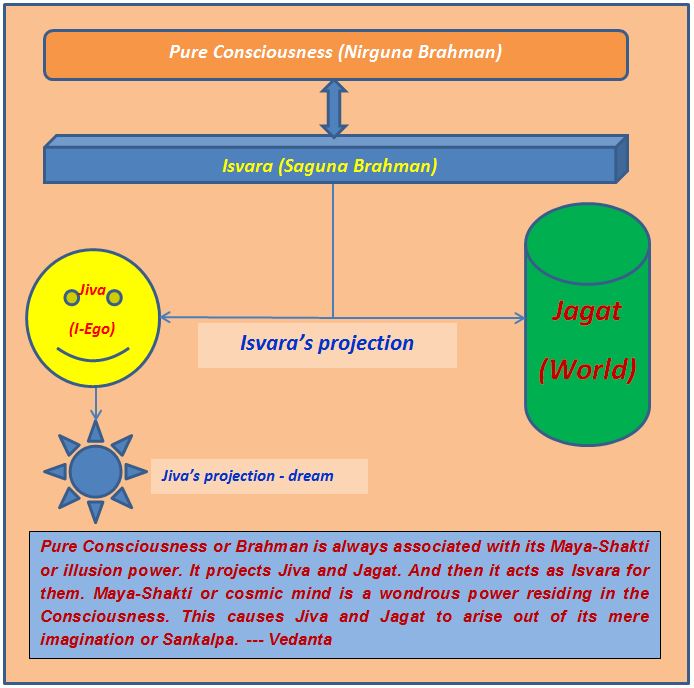
Pure consciousness through its Sankalpa [wish] or will-power projects this creation. Like the spider projects the web and later swallows the web inside. Upanishads mention about this Sankalpa of Brahman - "Akoham Vahusyam - I am one, I will become many".

This Brahman has an inherent wonderful power called Maya-Shakti. This makes him omnipotent. Through this Maya Shakti it projects cosmos. People also call this Maya Shakti as cosmic-mind. So this universe is the Isvara's dream creation - known as Vyavaharika Satya. Each individual also projects its dream world while sleeping - known as Prativashika Satya. And Brahman is known as Paramarthika Satya. So all these in living beings and Universe are in God's dream.

Jiva consists of 24 principle centred around 'I-EGO' or Ahamkara. These 24 principles are Pancha Bhuta, Pancha Tanmatra, Pancha Karmendriya, Pancha Jnanendriya, Manas, Buddhi, Chitta, Ahamkara. Jiva is deluded due to Avidya or ignorance of its true nature Brahman. Each soul is potentially divine. However Jiva forgot it - thinking himself as body-mind complex. This ignorance causes suffering.

Brahman is Satya-Sankalpa. So whatever He imagines manifests into reality or materializes immediately. Brahman is the best artist with excellent imagining capacity or potential. The same does not happen to Jiva due to its limitation. Whatever Jiva thinks it does not materialize into reality.

This creation is Isvara's divine Leela. It is created for divine fun or play. However creation is temporary. It manifests and unmanifests periodically. Brahman is eternal and it sustains creation. It is known as Sat-Chit-Ananda - Existence-Knowledge-Bliss.

Upanishads say - Raso-vai-Sah - He is like nectar. He is the source happiness or bliss. 

From one perspective it appears as Nirguna and from another perspective it appears as Saguna for seekers. So the same entity is both Nirguna and Saguna at the same time. Like with full-stomach in waking state, we can feel hungry while dreaming. So both full-stomach and hungry are true at the same time. Nirguna means niskriya [inactive], all attributes appear unmanifested, but it is not powerless. Brahman appears to be devoid of all attributes. Saguna means sakriya [active] with  all manifested triguna - Sattva, Rajo, Tamo Guna. Brahman is always associated with its inherent illusion power. We don't consider illusion power or Maya Shakti as separate because it does not have separate existence. Maya is associated with Brahman like a shadow with body. 


In the word's Sri Ramakrishna (Exerted from book THE PHILOSOPHY OF SRI RAMAKRISHNA, by SWAMI HARSHANANDA)

'God is formless, and God is possessed of form too. And He is also that which transcends both form and formlessness. He alone knows what all He is.' (Sayings of Sri Ramakrishna, 871).
Sri Ramakrishna calls the Absolute as Brahman, in Its eternal (nitya) aspect, when It is at rest and inactive. The same in Its sportive (lila) aspect, when involved in the process of creation, preservation and destruction, he calls Sakti or Kali, the same as Isvara or God. So, according to Sri Ramakrishna, Brahman and Sakti are one and inseparable. 'The distinction between Brahman and Sakti is really a distinction without a difference. Brahman and Sakti are one (abheda), just as fire and its burning power are one. Brahman and Sakti are one, just as milk and the whiteness of milk are one. Brahman and Sakti are one, just as a gem and its brightness are one. You cannot conceive of the one without the other, or make a difference between them' (Sayings of Sri Ramakrishna, 857).
'God the Absolute and God the Personal are one and the same. Belief in the one implies belief in the other. Fire cannot be thought of apart from its burning power, nor can its burning power be thought of apart from it. Again, the sun's rays cannot be thought of apart from the sun, nor the sun, apart from its rays. You cannot think of the whiteness of milk apart from its milky whiteness. Thus the Absolute cannot be thought of apart from the idea of God with attributes, i.e., Personal God and vice versa. (Sayings of Sri Ramakrishna, 856).
'The Primordial Power and Supreme Brahman are identical - It is like the snake and its wriggling motion.' (The Gospel of Sri Ramakrishna)

In Kena Upanishad Goddess Uma Haimavati taught the power of Brahman to Devas. Without His power, the Agni and Vayu are powerless. 

Thursday, July 9, 2015

Materialism philosophy and Scientific method.

Materialism philosophy and Scientific method.
(By Muktipada Behera)
Charvaka or Lokayata is the ancient school of Indian materialism. It is accepted as a valid school of Indian philosophy - an atheistic school in the Hindu tradition. Brihaspati is usually referred to as the founder of it.
The origins of the Charvaka can be traced to the Rigveda, but substantial discussions on the Cārvāka is found in post-Vedic literature. The primary literature of Cārvāka, such as the Brhaspati Sutra is missing or lost. So we need to depend on secondary literature such as those found in the shastras (such as the Arthasastra), sutras and the epics (the Mahabharata and Ramayana) of Hinduism as well as from the dialogues of Gautama Buddha and Jain literature.
The Carvaka epistemology holds perception as the primary and proper source of knowledge, while inference is held as prone to being either right or wrong and therefore conditional or invalid.
Perception are of two types, for Carvaka, external and internal. External perception is described as that arising from the interaction of five senses and worldly objects, while internal perception is described by this school as that of inner sense, the mind.
Inference is described as deriving a new conclusion and truth from one or more observations and previous truths. To Carvakas, inference is useful but prone to error, as inferred truths can never be without doubt. Inference is good and helpful. – For example of fire and smoke. When there is smoke, one's tendency may be to leap to the conclusion that it must be caused by fire. While this is often true, it need not be universally true, everywhere or all the times. Smoke can have other causes.
As long as the relation between two phenomena [observation and truth], has not been proven as unconditional, it is an uncertain truth. Such method of reasoning, that is jumping to conclusions or inference, is prone to flaw. Carvakas further state that full knowledge is reached when we know all observations, all premises and all conditions. But the absence of conditions, cannot be established beyond doubt, because some conditions may be hidden or escape our ability to observe. They acknowledge that every person relies on inference in daily life, but to them if we act uncritically, we err. While our inferences sometimes are true and lead to successful action, it is also a fact that sometimes inference is wrong and leads to error. Truth then, is not an unfailing character of inference; truth is merely an accident of inference. We must be skeptics, question what we know by inference.
Though complete truth about this cosmos cannot be known by only perception, still it ignores other methods of knowledge. It analyses all inexplicable events as (a) chance or unpredictability and (b) random or no-cause. This is where it is differing with the scientific spirit. Science does not accept (a) chance or unpredictability and (b) random or no-cause as a valid analysis. Rather it tries to find the underlying pattern of an event. Science sometime uses inference for microscopic events and cosmology. We need to be skeptics on those. And of-course theory changes and science evolves due to this skeptic in nature. 
Advaita Vedanta scholars considers six means of valid knowledge: Pratyakṣa (perception), Anumāṇa (inference), Upamāṇa (comparison and analogy), Arthāpatti (postulation), Anupalabdi (non-perception, cognitive proof) and Śabda (testimony of past or present reliable experts). While Carvaka school accepted just one Pratyakṣa (perception).
Therefore, Cārvākas denied metaphysical concepts like reincarnation, soul, efficacy of religious rites, other worlds (heaven and hell), fate and accumulation of merit or demerit through the performance of certain actions.  It embraces philosophical skepticism and rejects Vedas. They don’t believe in karma, rebirth or an afterlife. Cārvākas rejected conceptions of Hindus, Buddhists and Jains.
Cārvāka believed that there was nothing wrong with sensual pleasure. Since it is impossible to have pleasure without pain, Cārvāka thought that wisdom lay in enjoying pleasure and avoiding pain as far as possible. Unlike many of the Indian philosophies of the time, Cārvāka did not believe in austerities.
Their scripture states that – “The enjoyment of heaven lies in eating delicious food, keeping company of young women, using fine clothes, perfumes, garlands, sandal paste... while moksha is death which is cessation of life-breath... the wise therefore ought not to take pains on account of moksha. A fool wears himself out by penances and fasts. Chastity and other such ordinances are laid down by clever weaklings.” -- eat, drink, and be merry – is its philosophy.

There was no continuity in the Cārvāka tradition after the 12th century. But later many Indians got converted into hidden Charvaka due to influence of western science. However if we consider all six means of knowledge, then we will get complete knowledge and more accurate knowledge about creation.